


Is your cruise calling on Trieste Cruise Port? Trieste often sails under the radar compared to Italy’s blockbuster cruise ports but it may just be the most pleasant surprise of your itinerary!
In my Trieste Cruise Port Guide, I’ll share with you the top things to do in Trieste within walking distance of the cruise port, as well as suggest a few famous sites a bit further away. Trieste is often listed as one of the most underrated cities in Italy and rightly so! From grand squares opening into the Adriatic, ancient Roman ruins nestled in the city centre, historic literary cafes with Viennese echoes, get ready to discover the unexpected side of Trieste!
Cruise starting or finishing in Trieste? Then you may be interested in my Trieste Embarkation Guide, with all the tips for a DIY transfer from/to Venice or Venice Marco Polo Airport (VCE).
This blog post may contain affiliate links which may earn a commission for purchases made at no cost to you.
On This Page
Trieste Cruise Port: Is a DIY Excursion Easy? 😎😎😎😎😎 Easy-Peasy!
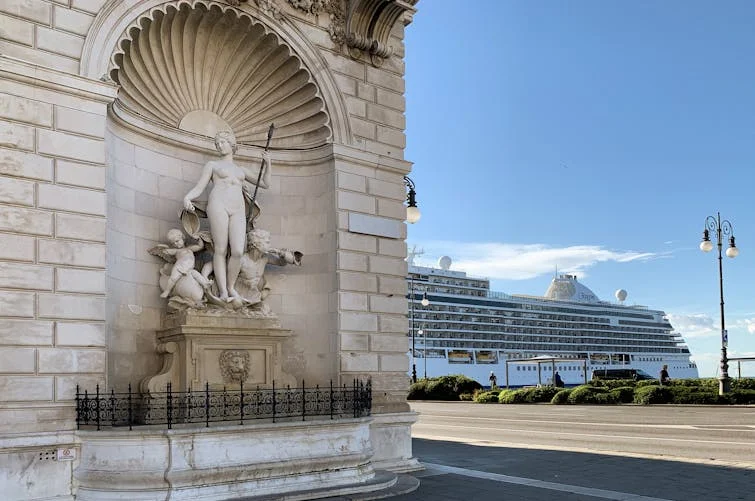
Trieste Cruise Port is a stone’s throw away from all the action in Trieste! Here’s why a DIY shore excursion at Trieste Cruise port is 😎😎😎😎😎 Easy Peasy:
- Location, location, location!: Step off your ship and you’re (almost) instantly at Trieste’s main square, the Piazza Unità d’Italia
- Walkable and well-connected: Key attractions are within walking distance, and buses are easy to use – pay with your contactless card!
- Coffee lover’s paradise: Explore the “Coffee Capital of Italy” and savour historic cafes and sweet treats (all marked on my Trieste Cruise Port map below!).
Trieste Cruise Port Essentials: All You Need to Know
- Trieste Cruise Port Address: Stazione Marittima, Molo dei Bersaglieri, 3, 34123 Trieste TS, Italy – see this marked on my Trieste Cruise Port Mapbelow 🗺️📍👇
- Currency: Euros
- Language: Italian
- Official websites: Tourism Venezia Giulia, TriesteMetro has a great series of cultural itineraries, TrenItalia’s English website for train timetables
- Recommended Transport App: Google Maps is best as Trieste Trasporti‘s website (local transit authority) is in Italian only
- eSIM for roaming in Italy: For a great data connection without the huge roaming fees, use an eSim data pack from Airalo. I always recommend having a smartphone with a valid plan when you’re at port touring independently. Get US$3 off your first eSIM data pack from Airalo when you use ROXANN1666 when you sign up or apply it at checkout
Trieste Cruise Port Map
- On Desktop | Laptop? Use buttons on bottom left to zoom in/out. Click on the upper right hand corner to see a bigger version.
- On Tablet | Mobile? Pinch your screen to zoom in/out and use two fingers to move map around. If you have Google Maps installed on your tablet/mobile, my map will open in your Google Maps app if you click on the upper right hand corner.
- If map is not loading correctly, click here to see it directly on Google Maps
Trieste Cruise Port: Top Things to Do
The following are all within walking distance of the port, unless otherwise noted. If you’re not sure, refer to my map above, as the attractions are all marked.
1. Visit Piazza Unità d’Italia: Trieste’s Majestic Heart

Piazza Unità d’Italia (Unity of Italy Square) is Europe’s largest seafront square! So stepping into Piazza Unità d’Italia is like entering a grand open-air ballroom with the sparkling Adriatic Sea as your dance floor.
For centuries, Trieste was a key port for the Habsburg Empire. Under Austro-Hungarian rule, Piazza Unità d’Italia was simply known as Piazza Grande (“Great Square”). The name changed when Trieste and the surrounding region were annexed by Italy (1918-1920).
How to Get to Piazza Unità d’Italia: You will definitely not miss Piazza Unità d’Italia! It’s almost directly opposite Trieste Cruise Port, so use this as your landmark to return to your ship.
What to See At Piazza Unità d’Italia
If you’re wondering what the respective buildings are, here’s an orientation tour! If you’re facing the square, with your back to Trieste’s harbour:

(a) Fontana dei Quattro Continenti
Fontana dei Quattro Continenti (Fountain of the Four Continents) is ahead of you, in the far end of the square. This 18th-century fountain represents the four known continents of the world at the time it was built (Europe, Asia, Africa, America) symbolising Trieste’s global trading importance. Statues allegorically represent the continents, with water features representing major rivers.
To the right hand side of the Fountain, you’ll see a Statute of Charles VI. This column honours the Habsburg Emperor Charles VI, who declared Trieste a free port in 1719, a crucial event that spurred Trieste’s growth and prosperity.
(b) Palazzo del Municipio (Town Hall)
Behind the Fountain of the Four Continents is the Palazzo del Municipio, Trieste’s City Hall, with a prominent clock tower. You may hear locals refer to it as Palazzo Cheba due to its somewhat eclectic, arguably “cage-like” (cheba means cage in local dialect) design elements.
It’s a working government building, so it’s generally not possible to walk in for a visit. However, you’ll find the Tourist Information Office on the ground floor here, if you need additional information for your visit in Trieste.
(c) Palazzo Stratti
Facing the Town Hall, the building on your left is Palazzo Stratti. The famous and historic Caffè degli Specchi (Cafe of Mirrors) on its ground floor – a perfect spot to soak in the atmosphere. Above the cafe are offices.
(d) Palazzo Pitteri & Grand Hotel Duchi d’Aosta
Facing the Town Hall, the building on your right are two buildings. Directly behind the Statue of Charles VI is Palazzo Pitteri – one of the oldest buildings in the square. (There’s a small convenience store here, if you’d like to pick up drinks and snacks before you continue your walk.)
The other is the Grand Hotel Duchi d’Aosta. The hotel is famous for Harry’s Piccolo, a fine dining restaurant with two Michelin star and a more informal bistro and bar called Harry’s Bistrò.
(e) Palazzo del Lloyd Triestino & Palazzo del Governo

From the entrance to Piazza Unità d’Italia (ie. the buildings closer to the harbour), the building on your right is the Palazzo del Lloyd Triestino (Palace of Lloyd Triestino). Formerly the headquarters of the influential Austrian Lloyd Triestino shipping company, it now houses offices of the Friuli Venezia Giulia Regional Presidency.
The building on your left is the Palazzo del Governo (Prefecture Palace), the offices of the regional government representatives.
2. Enjoy Coffee in a Traditional Coffee House

Trieste isn’t just a port city – it’s a mecca for ☕ coffee lovers! Trieste is known as Italy’s Coffee Capital. So if you drink coffee, definitely treat yourself to a visit to a historic coffee house in Trieste!
Since the 18th century, Trieste has been the main port for coffee imports for the vast Austro-Hungarian Empire. Its free port status made it a crucial hub for coffee arriving in Africa and South America.
This history led to a concentration of coffee-related businesses – importers, roasters and cafes. World-famous brands like Illy were founded and are still headquartered here! The Triestini (those who live in Trieste) supposedly drinks twice as much coffee as anywhere else in Italy!
Famous Historic Coffee Houses in Trieste

The historic coffee houses in Trieste often look rather Viennese inside, with marble, stucco, mirrors and dark wood. Here’s a few to choose from – all are marked in my Trieste Cruise Port Map above – I’ve deliberately picked a selection dotted around Trieste’s city centre, so you can pick one nearby when you feel like having a break:
- Caffè degli Specchi: Probably the most famous one is right at the Piazza Unità d’Italia. It’s often called the “drawing room” of Trieste. It opened in 1839 and its name “Cafe of Mirrors” refers to the mirrors used historically to enhance light. There’s indoor and outdoor seating and perfect for people watching on the square!
- Caffè Tommaseo: The oldest café in Trieste (opened 1830), known for its elegant interior with Belgian mirrors
- Antico Caffè Torinese: Noted for its well-preserved Art Nouveau interior with wood and brass fittings. Besides the cafeteria for coffee, sandwiches and snacks, there’s also a pastry shop here for takeaways!
- Cafe Pasticceria Pirona: Pirona is a historic pastry shop and cafe with beautiful Art Nouveau furnishings. It’s famously known as the cafe where James Joyce (the writer) visited frequently during his stay in Trieste, supposedly working on “Ulysses” while enjoying their pastries!
- Cafe San Marco: Relatively “new” in comparison to the others, Cafe San Marco opened in 1914 and has a restaurant and book store attached to it.
- Pasticceria La Bomboniera: If you’re looking for a spot for afternoon coffee, then come here for the sweet treats!
- Caffè Stella Polare: Another café frequented by James Joyce, as he taught nearby
3. Wander Around Trieste’s Roman Theatre

Built during the 1st century AD, the Roman Theatre (“Teatro Romano di Trieste“) is in remarkably good condition. While its stage and upper reaches have vanished over time, the stone seating and structure offer a fascinating glimpse into Roman life in ancient Tergeste (the Roman name for Trieste). Historians estimated that up to 6,000 spectators could be seated here on 3 separate levels.
Due to its location on the Adriatic Sea, Tergeste served as a vital port and trade hub for the Roman Empire. Under the reign of Emperor Augustus (1st century BC), the Romans built impressive walls with gates, towers and a forum.
For centuries, this historical Theatre lay hidden beneath houses and the bustle of everyday life. It wasn’t until the early 19th century that its existence was suspected with full excavation taking place in 1938.
How to Get There: The Roman Theatre is located right behind Piazza Unità d’Italia, at the foot of the San Giusto hill. It’s openly visible and free to view up close.
4. Explore Piazza della Borsa

Piazza della Borsa (“Stock Exchange Square”) is Trieste’s historic economic hub. The centrepiece of the square is its namesake building, the Palazzo Della Borsa Vecchia (Old Stock Exchange Building).
Finished in 1806, it’s in neoclassical style and designed to look like a Greek temple with grand columns. Today, it’s the Trieste Chamber of Commerce. Nearby is the Fontana del Nettuno (Fountain of Neptune), featuring the Roman God of the Sea, Neptune, symbolising Trieste’s maritime power of importance back in 1755 when the fountain was built.
Don’t miss the Palazzo del Tergesteo, an elegant 19th century building known for its glass-roofed internal gallery (arcade). This passage connects Piazza della Borsa with Piazza Verdi, where the Opera House is located and contains shops and cafes.
How to Get There: After your visit to the Roman Theatre, walk to the end of the street (Via del Teatro Romano) and then towards Trieste Harbour. Palazzo della Borsa is about 3 minutes’ walk (a block away) from the Roman Theatre.
5. Stroll around Canal Grande for a Venetian Vibe

Canal Grande is the centrepiece of the Borgo Teresiano district in Trieste and brings a touch of Venice into Trieste. The purpose of Canal Grande was primarily commercial, serving as a navigable channel extending from the port directly into the heart of the new commercial district of Borgo Teresiano.
The Borgo Teresiano district follows a grid-like street plan and was built on land reclaimed from former salt pans in the mid-18th century.
See the two domes in the photo? The central dome, sitting directly at the inland end of the canal beyond the bridge belongs to the Chiesa di Sant’Antonio Taumaturgo (Church of St Anthony Thaumaturge). The dome on the right belongs to the Chiesa Serbo Ortodossa di San Spiridione (Serbian Orthodox Church of Saint Spyridon)

Don’t miss the James Joyce statute on Ponto Rosso (Red Bridge), the fixed bridge – marked on my Trieste Cruise Port map. Joyce lived in Trieste for well over a decade and wrote Dubliners and A Portrait of the Artist as a Young Man in Trieste. He also started his magnum opus Ulysses in Trieste. If you’re interested in James Joyce, then see this DIY walking tour of all the places that he spent significant time in, whilst in Trieste.
6. See a Panoramic View from Castello di San Giusto

The Castello di San Giusto (San Giusto Castle) sits on San Giusto Hill, the historic heart of Trieste. The hill has been a strategic site since prehistoric times and later became the centre of Roman Tergeste when the Roman civic buildings and fortifications were housed there.
During the Hasburg era, it served as the residence of the Habsburg Imperial Captain and later, as a military garrison and prison. The museum complex, as we see it today, was opened in 1936.
How to Get to Castello di San Giusto: Your Transport Options
- Walk: It’s about a 1km (~0.6 miles) walk from Piazza Unite d’Italia but note much of it is uphill
- Public Bus: From Trieste Cruise Port, walk a few minutes to bus stop “via Diaz” – see my Trieste Cruise Port map above – and catch bus #24. Tap your contactless card to pay the fare of €1.45. Get off at “San Giusto” stop for the Castello.
- Hop on Hop off Bus (HOHO): Stop #6 on the “Hop Tour” (Trieste’s HOHO bus) – see below for more information on the HOHO bus.
What to See at Castello di San Giusto
Castello di San Giusto now houses important sections of Trieste’s Civic Museums of History and Art:
- Civico Museo del Castello di San Giusto (Civic Museum of the Castle): Located with the former Captain’s House, there’s an armoury showcasing weapons from the 12th to 19th centuries and the small, late-Gothic Cappella di San Giorgio (St. George’s Chapel)
- Lapidario Tergestino (Tergeste Lapidarium) with a large collection of Roman stone artefacts found in Trists, from inscriptions, to sculptures found at the Roman Theatre
- The Viewpoint: From the castle’s ramparts, enjoy panoramic views of Trieste, the Adriatic Sea, and the surrounding hills.
- Opening Hours: 10am to 7pm daily from 1 April to 30 Sept. 10am to 5pm Tuesdays – Sundays from 1 October to 31 March.
- Tickets: €6 for adults, €4 for kids
- Helpful Info: Download a DIY Guide of the Castello here to your phone (PDF)
7. Marvel at Mosaics in St Justus Cathedral

The Cattedrale di San Giusto (St Justus Cathedral) is located right next to Castello di San Giusto, so if you visit the Castle, then definitely stop by the Cathedral to see the Byzantine mosaics.
St Justus Cathedral used to be two churches! From 9th to 11th centuries, two churches stood side-by-side on the site, which themselves were built on Roman-era foundations, including a temple: one dedicated to Santa Maria Assunta (Our Lady of Assumption) and the other to San Giusto (Saint Justus), the patron saint of Trieste, who was martyred nearby.
In early 14th century, a decision was made to merge the two basilicas, so the inner aisles of each church was demolished to create one large, central nave, resulting in the unique five-nave structure. The church we see today dates back to 1385.

The most striking features of the Cathedral are the stunning 12th-13th century Byzantine-style mosaics. On the left apse (from the former Santa Maria) is a radiant depiction of the Madonna Enthroned with the child Jesus, flanked by Archangels Michael and Gabriel, with the figures of the twelves Apostles below. On the right apse (from the former San Giusto) is Christ enthroned in Glory between Saint Justus and Saint Sevolus.
These Byzantine mosaics are in as good condition as those in Ravenna, so it’s worth taking a quick look even if you’re generally not interested in churches. Entrance to the cathedral is free.
8. Revotella Museum: Art Museum in a Palazzo
The Revoltella Museum was founded by Baron Pasquale Revoltella, who bequeathed his opulent mid-19th century residence and his vast art collection and furnishings to the city of Trieste to create a public museum of “modern art”.
Opened in 1872, the Revoltella Museum’s focus is primarily Italian art from the 19th and 20th centuries. But I think the highlight is Baron’s Revoltella’s Historic Apartments. The lower floors of the Palazzo Revoltella is very well preserved, plus the rooftop terrace provides splendid views over the Gulf of Trieste and the city.
This is a nice “bad weather back-up option”, too, as there’s 7 floors to browse through and close by Trieste Cruise Port for an easy hop back to the ship afterwards.
- How to get there: 3-5 minutes walk from Trieste Cruise Port
- Opening Hours: 9am to 7pm daily except Tuesdays. Note that the museum is partially closed for renovations until 7 May 2025.
- Tickets: €8 for adults, €6 for concessions.
9. Soak Up the Sunshine at Molo Audace

Molo Audace is a long, elegant sone pier, extending directly from the waterfront edge of Piazza Unità d’Italia. This is an excellent spot to take photos with your ship behind you!
Originally built in 1743, partly on the wreck of a sunken ship called the San Carlo, Molo Audace was originally named Molo San Carlo. Its name was changed, in 1918, in honour of the Italian Navy destroyed “Audace” – the first Italian warship to enter the port and dock at this pier, symbolising Trieste’s unification with Italy.
Today, it’s just serves as a promenade. If you stand in Molo Audace and look back towards the Piazza, you’ll get a viewpoint for appreciating the square’s grandeur.
Trieste’s Hop-On Hop-Off Bus: Is it Worth It?
Trieste’s Hop-On Hop-Off Bus is called the Trieste HopTour. There’s 13 stops on the route and you’ll find a map of the HOHO bus route here.
Worth It: I would say that it’s worth it, if you’d like to go to Miramare Castle (stop #10) and Castello di San Giusto (stop #6) but don’t want to navigate local buses. The HOHO bus is a good alternative, as it stops at both castles. (Note the stop at Miramare Castle is 700m walk from the entrance gates.)
Otherwise, beware of:
- HOHO bus runs less frequently Monday to Thursday, with only 5 timetabled services a day – miss it and you’ll have to wait for two hours for the next one. It’s better on Fridays, Saturdays and Sundays, with 10 timetabled services
- Walk in Trieste City Centre is still needed, if you intend to get off and see some attractions. You’ll notice on the map that the bus stops are not necessarily where the attractions are!
Tickets: Adult tickets are €17 and kids’ tickets (5-16) are €14
Further Afield: What to See Beyond Trieste’s City Centre
Trieste is also used as an embarkation port by NCL and sometimes by Cunard and Princess Cruises, too. If you arrive in Trieste the day before your cruise starts and has extra time on your hands, here’s three ideas for what to see slightly outside of Trieste’s city centre.
Alternatively, if you’ve got a long port day, then Miramare Castle is definitely worth taking the bus and enjoying it for a few hours before heading back to Trieste.
1. Miramare Castle: Fortress by the Coast

Probably the most photographed attraction in Trieste (besides the Piazza), the Miramere Castle is a dazzling white castle perched on a rocky cliff facing the Adriatic Sea. No wonder it’s so Instagrammable!
Miramare Castle is a 19th-century marvel that captures the essence of romance and coastal grandeur. Built by Archduke Ferdinand Maximilian of Austria (and his wife, Charlotte of Belgium) in the mid-1800s, Miramare blends architectural styles and reflects the couple’s passion for travel and the sea. (He also purchased Lokrum Island in Dubrovnik in 1859 and converted it as a summer residence.)
Maximilian envisioned Miramare as a haven for himself and his wife, Charlotte of Belgium, after renouncing his claim to the Austrian throne. He was then offered the crown of Mexico in 1864.

Maximilian’s reign as Emperor of Mexico was short-lived and volatile. Facing local resistance and the withdrawal of French support, he was captured by Republican forces and executed in 1867, just three years after leaving Miramare. News of Maximilian’s death devastated Charlotte, who is believed to have suffered a mental breakdown. She spent the rest of her life in seclusion, never returning to Miramare.
The castle’s lavishly furnished rooms all have ornate decor, portraits of the Habsburg family and mementos reflecting the Archduke’s naval career. There’s also meticulously manicured gardens to enjoy.
- How to get there:
- Bus: Walk towards the station to stop on “Via Ghega” (see my Trieste Cruise Port map above), catch #6 to “Venezia Giulia”. Then walk down to the entrance gates. Use your contactless card to pay the €1.45 fare. Bus takes about 20 minutes. Let the driver know you’re heading to Miramare Castle.
- Train: Walk to Trieste Centrale station (about 15 minutes away), then catch the local train to Miramare station (10 minutes). Then walk down to the Castle (signposted). Note the train runs less frequently than the bus, so do check the train schedule for your return journey.
- Journey time: Approx. 45 mins from Trieste Cruise Port one-way including walking time to/fro bus stops
- Opening Hours: Castle opens daily 9am to 7pm. Gardens open earlier at 8am. Double check opening hours here.
- Tickets: Park is free to enter but the Museum ticket is €17 adults, kids under 17 is €3. EU citizens (with ID) aged 18-25 can book youth tickets for €5. You can also visit the historic kitchens at 2pm daily for €7 extra – book at castle.
- If you intend to visit the museum (ie. castle itself), be sure to pre-book online first. Tickets are sometimes sold out. It’s also a bit of a trek to get there, so I’d like to know I’ve secured a ticket before heading there!
2. Risera di San Sabba

Stepping into the Risiera di San Sabba (San Sabba Rice Mill National Monument & Museum) is a sobering experience. This former rice processing plant was transformed into a Nazi concentration camp and execution site during World War II.
The site was used to detain political prisoners and a transit camp for Jews, most of whom were then deported to Auschwitz. The cremation facilities were destroyed before the camp was liberated and were the only ones built inside a concentration camp in Italy. It is estimated that thousands were killed in the Risiera camp itself. Thousands more were transported elsewhere.
Today, it serves as a memorial to the victims of Nazi atrocities and museum. The main exhibition chronicle the history of the Risiera, from its pre-war days to its dark chapter as a concentration camp.
- How to Get There: Check next bus departure with Google Maps to decide which route to take!
- Bus #8: From cruise pier, catch Bus #8 right outside cruise pier. Get off at “Cimitero” stop and walk about 5 minutes. Pay the €1.45 fare with your contactless card onboard. #8 runs approx. every 15 minutes.
- Bus #10: Walk from cruise pier to Piazza Tommaseo (see my Trieste map above). Get off at “Via Valmura” and the museum is 2 minutes away. #10 runs approx. 10 minutes.
- Journey Time: About 30 minutes each way
- Opening Hours: 9am – 7pm daily from 1 April to 30 September, 9am to 5pm from 1 October to 31 March. Admission is free.
- Exhibition Information Leaflet: Download the official info leaflet here (PDF) or watch this YouTube video.
3. Grotta Gigante: Journey into the Earth’s Depths

Descend into the heart of the Karst plateau and experience the awe-inspiring power of nature at the Grotta Gigante. This colossal cave boasts the world’s largest single chamber accessible to tourists, a breathtaking underground world formed over millions of years. As you follow the guided path, marvel at the towering stalactites and stalagmites, their otherworldly shapes sculpted by the relentless force of dripping water.
The highlight of the Grotta Gigante is the “Grande Caverna”. This vast, cavernous space could easily hold a cathedral, leaving you feeling dwarfed by nature’s immense scale. Imagine the echoes of your footsteps as you explore this subterranean wonderland, a fascinating reminder of the hidden world lying beneath our feet.
Grotta Gigante offers a unique and unforgettable way to experience the raw beauty of the natural world. If you have a sense of adventure and a love of geological wonders, this day trip from Trieste is well worth considering. It’s a major attraction in the Trieste area, so it’s surprisingly easy to get to via public transport! I rated it 😅😅😅 (Takes Effort) because there’s lots of stairs climbing for the cave tour, not because it’s hard to get to.
- How to get there: Catch #42 from the outside Trieste central station (Via Miramare) and get off at Grotta Gigante stop. Pay bus fare with your contactless card.
- Journey time: The walk to Trieste station takes about 15 minutes from cruise pier. Bus journey takes about 30 minutes.
- Opening Hours: Open Tuesdays to Sundays from Sept to June. Daily during July and August. Pre-booking your time slot is essential!
- Pre-booking Required: Admission must be pre-booked, for both the 1-hour guided tour and the 4-hour “Speleo Adventure”. 1-hour guided tours are €15 adults, €12 for seniors (65+) and €8 for kids.
- Not suitable for those with mobility issues: There are stairs (no lifts) that lead you down to the 100m deep cave. For those who are afraid of heights (like me), there are hand rails all throughout.
- Bring a jacket! It’s cool inside the caves. Around 10C (50F) all year round. So bring a jacket or sweater.
Featured Image by Gerhard Bögner from Pixabay
Your Trieste adventure awaits! Whether you seek grand piazzas, hidden cafes, or echoes of history, this unique port city is yours to uncover. So, grab your map (and maybe a cappuccino!), step off your cruise ship, and let Trieste captivate you. If you love this guide, please share it with fellow cruisers!


Thank you SO much for your fabulous website. I have spent hours upon hours researching each port city for our cruise and was so happy when I found your website. You have saved me well over another 20 hours of research. You mentioned that several cruise lines are now docking in Trieste instead of Venice. Could you provide guidance on how to DIY getting to Venice from Trieste?
Hi Wendy, really pleased to hear that you’ve found my travel blog helpful! Glad to know that it has saved you some time in your travel planning. I’m not sure whether you’re asking because you’re hoping to do a day-trip to Venice when your ship is calling at Trieste or you’d like to head to Venice after your cruise ends in Trieste. So it’s a long reply!
Firstly, I would not recommend a day-trip to Venice (if your ship is just docking in Trieste for the day), as it’ll be about 5 hours of travel, even if you time your trains right.
If your cruise ends in Trieste and you’re heading to Venice, then the DIY transfer from Trieste to Venice is straightforward. Trieste Centrale station is a 15-minute walk away or you can take a taxi from Trieste Cruise Port – it’s marked on my Trieste Cruise Port map above.
Direct trains from Trieste to Venice Santa Lucia station (main station in Venice) takes 2 hours. Check timetables here. If you pre-book tickets in advance, you can change the time of your train before departure without penalty in Italy. One-way fares start from €18.
If you’ve going to Venice Airport to head home, then I would recommend that you get off at Venice Mestre instead and change for the airport bus outside the station. Venice Mestre is always easier, without swamps of tourists! You can read more about the airport buses between Venice City Centre and Venice Airport is my Venice Marghera embarkation guide. Hope this helps!
Thank you so much! I wasn’t expecting such a quick (and wonderfully thorough response). I am going to be sharing your website on the Roll Call for my cruise so everyone can see what an awesome guide you have created. :-)
The trip ends in Trieste and I fly out of Venice the next day. In looking through your sight, I did not see a guide specific to Venice but would love your thoughts/opinions regarding what to do in the short time we have and how to get to Marco Polo airport when you are on the island. I’m staying the night near the Palazzo Ducale and from what I am seeing, taking a water taxi will cost an arm and a leg! Thanks again!
Hi Wendy, thanks so much for sharing my travel blog – I really appreciate it! Venice is on my list to write detailed guides for (hopefully soon!), as I spent 4 nights in Venice before a cruise last summer and I’m yet to write up my experiences there. It’s been on my low priority list, as cruises don’t really visit Venice anymore.
If it’s your first time in Venice, then I would recommend (a) soaking up the atmosphere in Piazza San Marco – especially around sunset time (b) visit Palazzo Ducale if you like museums (c) see St. Mark’s Basilica (d) go on a water bus on the grand canal, a gondola ride is about €80-€100 (e) walk the Rialto Bridge for a fabulous view of the Grand Canal. Prioritise Palazzo Ducale and St Mark’s Basilica for your afternoon, as the rest you can do till late into the evening.
From Palazzo Ducale, the easiest way to get to Venice Marco Polo airport is to catch the Blue Line Alilaguna water bus. It’s €18 per person and takes about an hour but it’s almost door to door service! You can read more about what I wrote about the Alilaguna water bus here. You can hop on the Alilaguna from San Marco stop, right at the entrance to Piazza San Marco and should be very close to your hotel.
Hope you’ll have a wonderful time!
FYI – for others: My Trieste Embarkation Guide on how to get from Venice or Venice Airport to Trieste Cruise Port is now live:
https://diycruiseports.com/embarkation/venice-to-trieste-cruise-port-diy-transfers-guide